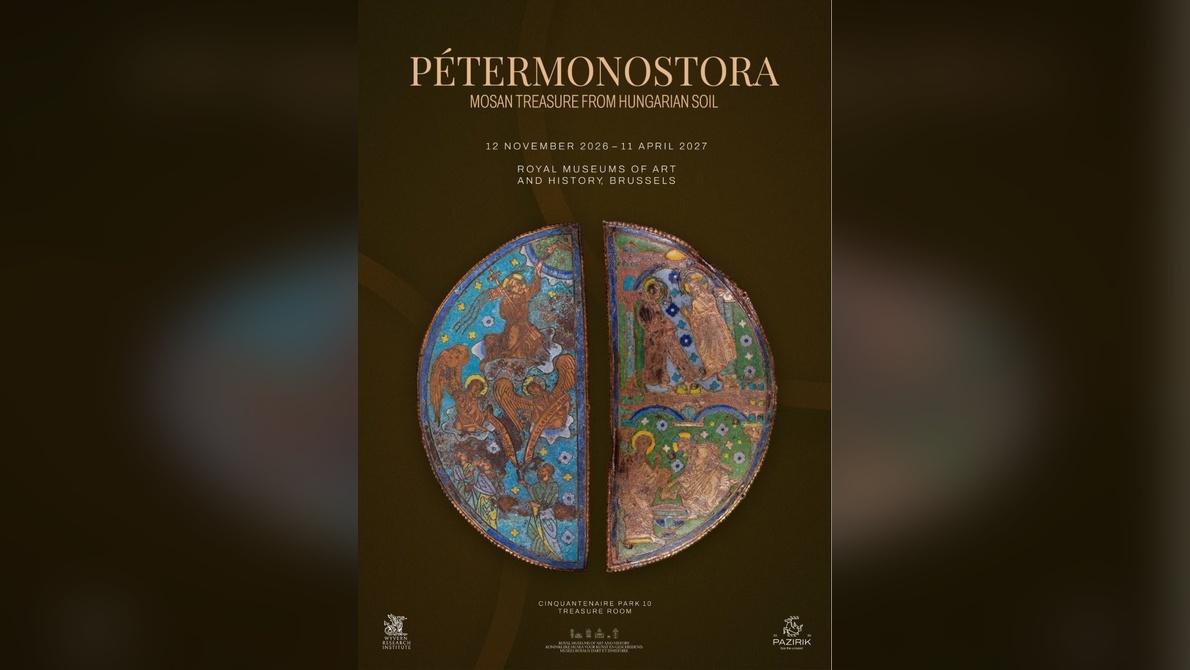
The Royal Museums of Art and History are immensely honoured to welcome, for the duration of an exhibition, two exceptional Mosan enamel plaques discovered during excavations of the monastic complex at Pétermonostora, Hungary.
Mosan enamels found in an archaeological context are exceptionally rare. These two semicircular plaques, decorated with figurative champlevé enamels depicting the Ascension of Christ and the Washing of the Feet, were made around 1170 by a goldsmith trained in the Mosan tradition. They most probably formed part of the remains of a large polylobed phylactery reliquary, destroyed when the abbey was sacked during the Mongol invasion of 1241–1242.
Beyond the spectacular nature of this discovery, these works shed new light on artistic, religious, and commercial exchanges between the Mosan region and medieval Hungary.
The plaques are displayed at the heart of the Treasure Room, alongside emblematic examples of Mosan art, such as the Stavelot portable altar and the reliquary gables from Maastricht. They are accompanied by a reconstruction of the two enamels produced by Pazirik Ltd.
Complementing the exhibition, an international study day will bring together researchers and specialists on 20 November 2026 to explore this exceptional discovery in greater depth, furthering the study of the fragments and examining the relationships between the Mosan region and Central Europe during the Middle Ages.
Admission: the exhibition is accessible with the general admission ticket to the permanent collection.
Explore the study day